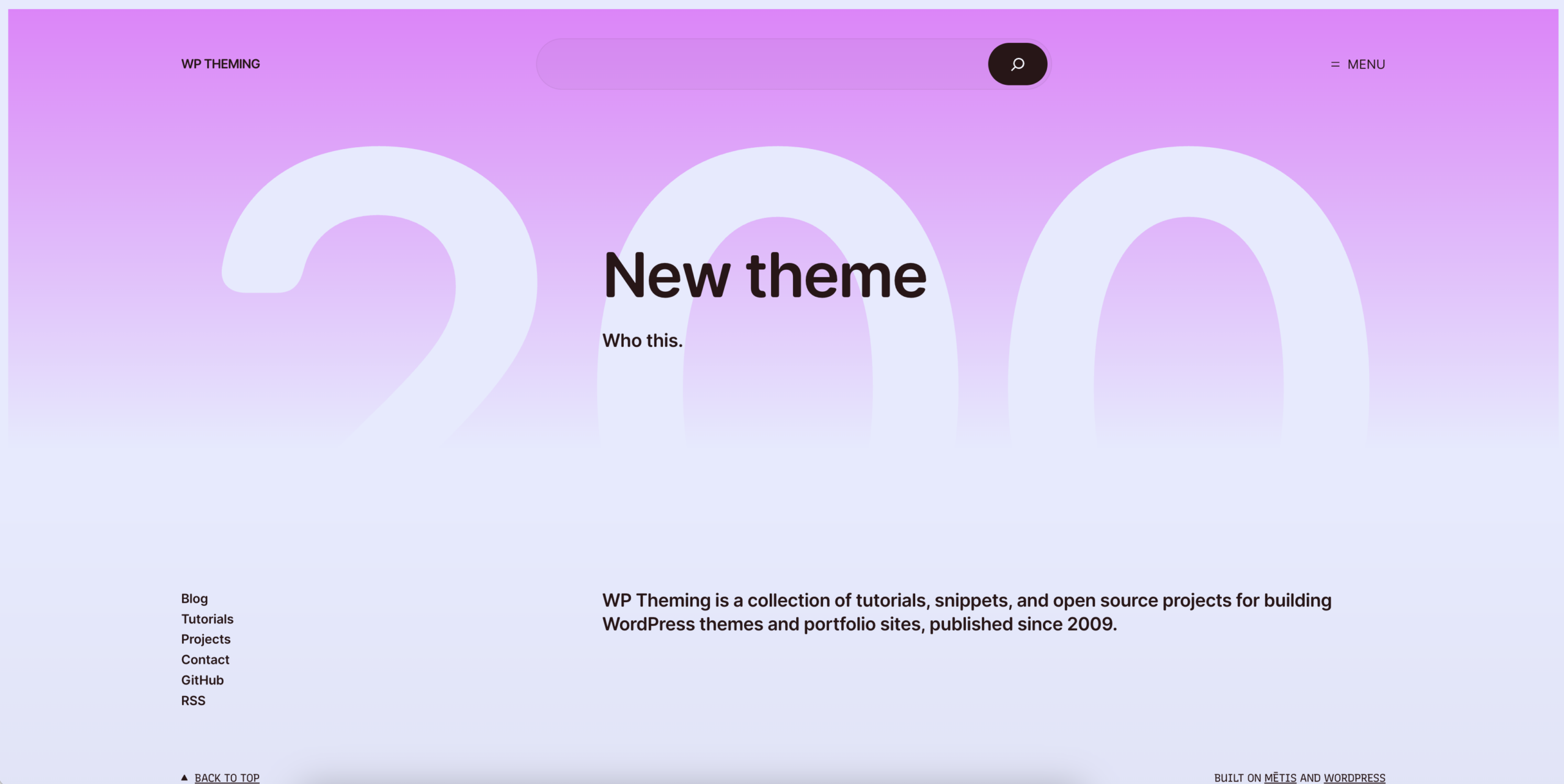
Until a few days ago, I hadn’t touched this website in years. The WordPress theme I had installed was one I handcrafted over a decade ago (and loved building!), back in the days when we typed out css and pushed our own git commits.
I have largely sat on the sidelines as the WordPress site editor developed. I never liked the idea of setting the design in the database, where I didn’t have version control or a clear way to deploy it from local to production.
The goal of the site editor, I believe, was to give non-technical users the ability to design a site how they wanted (ala Squarespace), which is laudable. But every time I tested a new theme, I wasn’t able to get the exact outcome I wanted, and the controls for the patterns were often difficult for me to find.
What changes with AI
AI upends both surfaces. It’s trivial to write code and it’s trivial to update settings, and you can do both just by telling an AI the outcome you want. So do we even need WordPress themes anymore? And if so, what would make a WordPress theme good?
At Universal Yums I’ve been building mostly internal business apps with Laravel, using shadcn/ui as our frontend. AI works amazing with shadcn/ui. The interfaces come out really nice with minimal direction. This is because shadcn has solid design patterns and excellent documentation, so an LLM knows which components to use, and when it fits them together they look good and cohesive.
In the age of AI, I think those are also the most important qualities of a WordPress theme. It should have strong design patterns that look cohesive when put together, and the documentation should be clear enough (in code or otherwise) that an LLM can quickly assemble a site that looks great.
Trying Mētis

I ran across the Mētis theme from this post in The Repository. It’s a new block theme from Automattic. It started as a direction for the next default theme, but WordPress went with a blank-canvas theme called Ipsum for that instead. Mētis is now the flagship theme.
It comes with six starter sites (Magazine, News, Personal, Portfolio, Writer and Business) built from one library of around 80 patterns. It also has six style variations and a dark mode switch. It requires WordPress 7.1, and for now it’s on GitHub rather than in the theme directory.
I didn’t look at the code. I didn’t edit anything in the block editor. I just asked Claude to set it up on my site and had it flip colors and fonts until we arrived at something I was happy with, and five minutes later we were done.
By that measure, it is a good WordPress theme for the age of AI.